BiblioBios: Associate librarian and rare materials cataloger, Dean expands access to Spencer’s collections
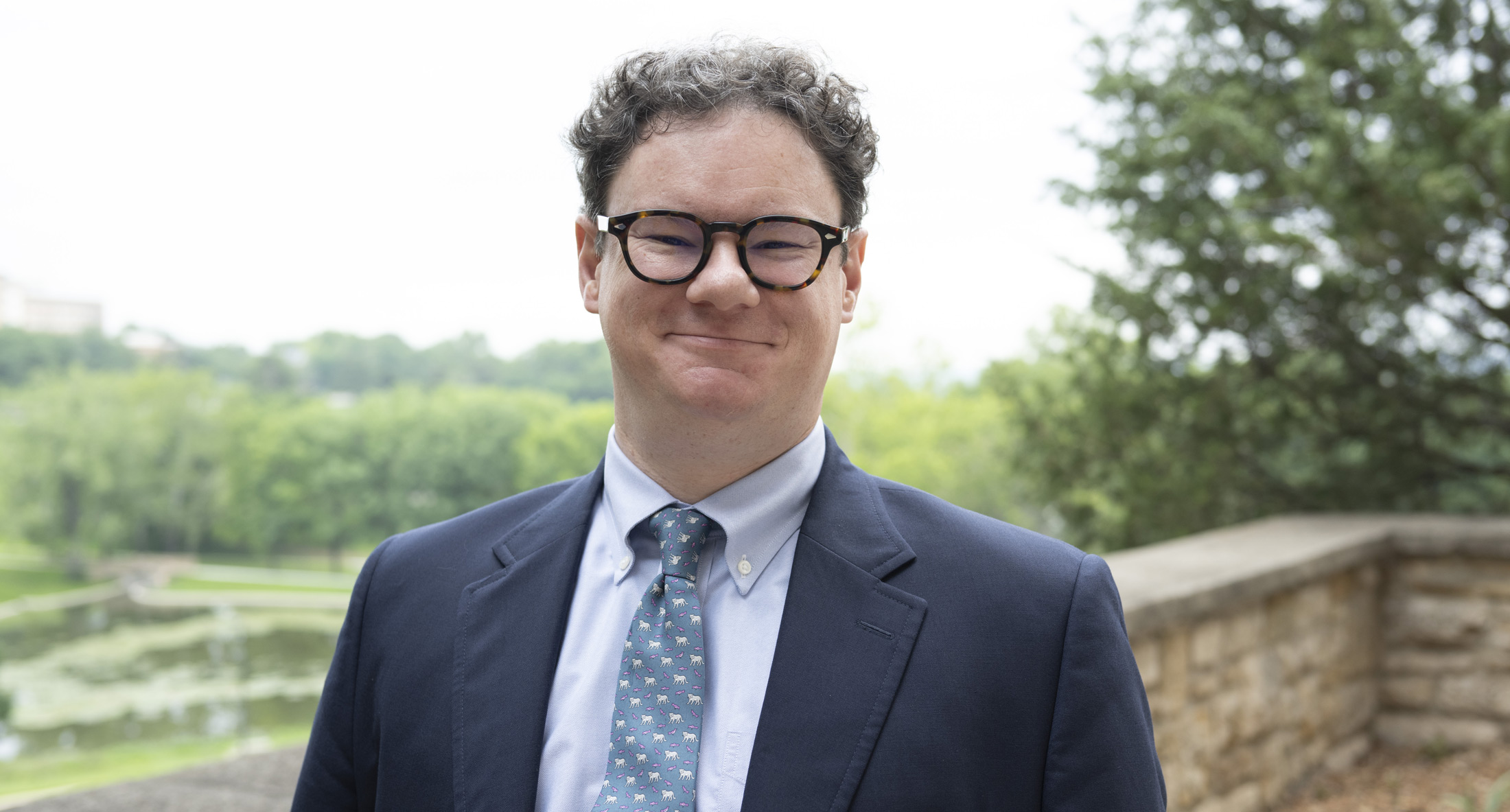
For more than a decade, Jason W. Dean has built a career around making rare and often inaccessible materials discoverable, understandable and usable for scholars around the world. As an Associate Librarian and Rare Materials Cataloger at the University of Kansas Libraries’ Spencer Research Library, Dean works at the intersection of bibliography — the activity of describing books as physical objects and artifacts, rather than simply carriers of text — and cataloging, ensuring that rare materials are not only preserved, but meaningfully described and discoverable for current and future research.
Dean’s path to librarianship began far from Lawrence, in Midland, Texas, a flat West Texas town defined by the petroleum industry, expansive skies and a strong sense of self‑reliance. Growing up in the Midland left a lasting impression.
“When I go back to where I grew up, the thing that strikes me is the sense of horizon and sky and space,” Dean said. “I think that’s the overwhelming thing I remember from growing up in Midland.”
While his family in Midland worked in oil and gas, Dean knew early on that he wanted something different. That desire for exploration, paired with an openness to new directions, would eventually shape his professional life.
Dean earned a bachelor’s degree in history from Hardin‑Simmons University in 2005, where the discipline pushed him in new ways.
“History was the first class that really challenged me in college because it was all essay exams,” he said. “It taught you how to think and how to write, and I really enjoyed it.”
After graduating, Dean spent two years teaching high school history in Texas. Living in Fort Worth at the time, he found himself drawn instead to the many museums and cultural institutions there, including the Amon Carter Museum of American Art and the Kimbell Art Museum.
“I thought about what I really enjoyed doing,” Dean said. “One of the things that drew me to librarianship is the ability to learn and read about and interact with all sorts of different areas of knowledge. I found that in librarianship, which is a profession for the perennially curious.”
That curiosity led Dean to library school at Syracuse University and, soon after, to his first hands‑on experiences with rare books. While still a graduate student, he worked at the Amon Carter Museum, where a strong art research library introduced him to rare materials and cataloging.
“When you interact with a rare book, you know that this object has lived a life before it comes to you,” Dean said. “It was interesting to figure out how to tell that story using the object itself.”
After completing his degree, Dean moved to Arkansas to work at Crystal Bridges Museum of American Art in Bentonville. There, he helped catalog a growing collection of rare American imprints assembled by founder Alice Walton. With guidance from leading Americana bookseller William S. Reese, Dean deepened his skills in rare book description and research, solidifying his commitment to rare materials cataloging as a career.
Those experiences eventually brought Dean to Spencer Research Library, where he has a focus on books printed between 1455 and 1850, and catalogs newer rare books and other formats of materials such as maps and VHS tapes. His work centers on detailed descriptive cataloging, work he sees as foundational to the existence of a library itself.
“Without something described in the catalog, it really doesn’t exist,” Dean said. “You can’t lay your hands on it, and you don’t know that it exists in the library.”
Dean emphasizes that libraries are not simply warehouses of books. What distinguishes libraries from warehouses are a commitment to access, expert staff, and careful description. At Spencer, his cataloging work is detailed enough that scholars across the world can determine whether a physical visit is necessary or whether the catalog record itself provides sufficient information.
Beyond local description, Dean contributes nationally to item discoverability through name authority work, creating standardized records that help identify historical individuals across collections.
“People 20 years from now won’t have to do the same work twice,” he said. “They can discover who someone was because that research already exists.”
Dean’s research interests extend into early modern science and bibliography. He is currently collaborating with British scholar Emma Hill on the first census of surviving copies of John Flamsteed’s Hisotira Coelestis of 1712, documenting variations across surviving copies. He is also working with historian Nick Wilding to revise and expand a major census of Galileo’s “Sidereus Nuncius,” the 1610 work that announced Galileo’s early telescopic discoveries, where Dean and Wilding are drawing upon the work of previous scholars and expanding that work based on discoveries they’ve made.
Dean’s bibliographical work is deeply influenced by the long tradition of descriptive and analytical bibliography at KU. He points to figures like Charlton Hinman, an important bibliographer and longtime KU professor, whose groundbreaking work on Shakespeare’s First Folio helped establish Spencer Research Library as a center for bibliographical scholarship.
“We’re continuing a long tradition here,” Dean said. “And I look forward to expanding that through my cataloging and my research.”
Central to Dean’s professional philosophy are the values of access, privacy and sharing. He views rare book libraries as places that take expensive, difficult‑to‑access materials and make them freely available for study.
“We help to support and fuel future inquiry,” he said. “We don’t know how materials will be used in the future, and that’s part of why access and description matter so much.”
Dean was recently elected a Fellow of the Society of Antiquaries, an honor recognizing significant contributions to the study of the past. He has also been invited to join the Association Internationale de Bibliophile (International Association of Bibliophiles), an international organization dedicated to the appreciation and study of books and manuscripts, reflecting his expertise, scholarship and commitment to the field.
Dean also maintains a range of personal scholarly interests, including photography, which he studied as an undergraduate and continues to collect, and religious and cultural art forms such as santos, retablos, and katsina figures. He sees these objects, much like books, as physical traces of the people and cultures that created them.
That idea carries into “Half Sheets to the Wind,” a monthly newsletter he co‑writes with longtime friend Rhiannon Knol, which began during the pandemic. Blending rare books, bibliography and humor, the newsletter explores themed topics, from utopias to ghosts, while highlighting collections and conversations from the rare books world.
“We’ve gone from nobody to nearly 400 subscribers,” Dean said. “It’s a lot of fun, and it gives us a way to share what we love with a wider audience.”
At Spencer, Dean continues to describe, research and contextualize rare materials, helping scholars connect with objects that carry centuries of history. For him, the work is ultimately about curiosity, care and continuity, ensuring that the stories embedded in books remain visible and accessible, long into the future.
BiblioBios shine a light on the people behind the collections, programs and services in KU Libraries. Find your link to important information and resources by connecting with our faculty and staff through the KU Libraries Directory.